Quick Facts
- Market Lead: The MSCI China Index has surged nearly 30% year-to-date in 2026, marking its strongest performance relative to US markets in nearly a decade.
- Valuation Edge: Chinese equities trade at a forward P/E of 10.87, representing a significant discount compared to the historical highs of the S&P 500.
- Earnings Rebound: For the first time since 2022, earnings growth for major Chinese technology firms is expected to exceed that of the U.S. Magnificent 7.
- Dividend Appeal: The projected dividend yield for the CSI 300 Index stands at 2.7%, significantly higher than the 1.7% yield offered by AAA-rated renminbi corporate bonds.
- Sector Diversification: The current rally has expanded beyond internet giants to include materials, healthcare, and renewable energy, broadening the base of the recovery.
- Yield Advantage: Investors are finding a 100-basis-point yield gap in favor of stocks over bonds within the domestic Chinese market, incentivizing a shift from fixed income to equity.
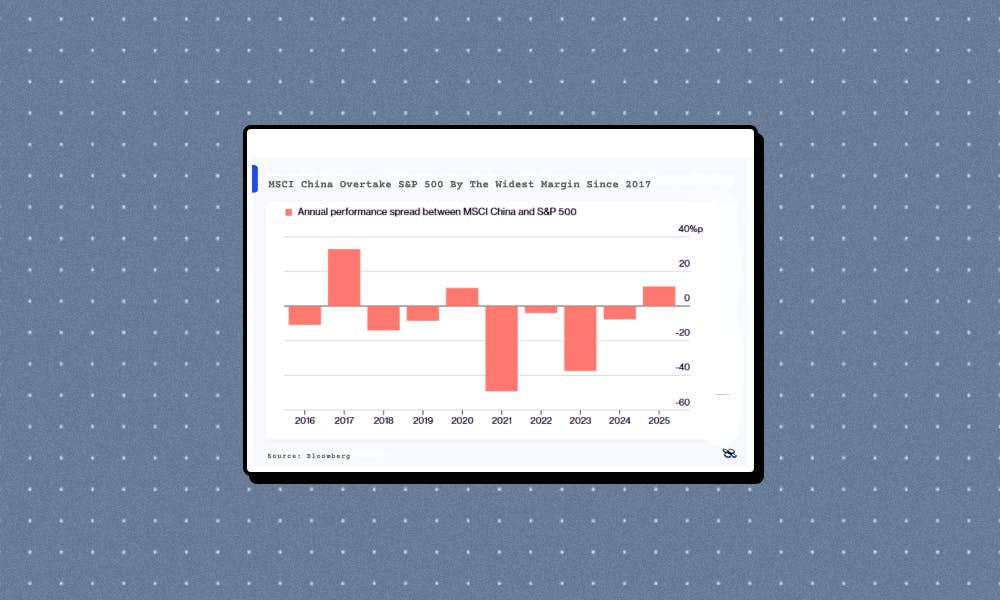
As of early June 2026, a significant shift in global capital is underway. Chinese stocks are outperforming the S&P 500 by the widest margin since 2017. While the US market grapples with high valuations, the MSCI China Index has surged nearly 30% year-to-date. This rally isn't just a tech story; it's a structural realignment driven by undervalued equities and robust domestic growth engines. In this guide, we break down the four fundamental reasons behind this outperformance and what it means for your portfolio allocation.
Chinese stocks are outperforming the S&P 500 in 2026 due to a broadening rally that began in the tech sector and spread to materials, healthcare, and entertainment. This performance represents the largest gap between Chinese equities and the S&P 500 since 2017, supported by a nearly 30% rise in the MSCI China Index. Key drivers include record-breaking metal prices for commodity producers and new international licensing deals for healthcare firms.
Reason 1: The Massive Relative Valuation Gap
For the disciplined long-term investor, the most compelling argument for the current market rotation is the stark relative valuation gap between East and West. By mid-2026, the S&P 500 continues to trade at multiples that reflect high expectations for AI-driven productivity, while Chinese markets have been priced for a "worst-case" economic scenario that simply hasn't materialized.
As institutional fund flows seek refuge from expensive US valuations, the MSCI China Index presents an increasingly rare opportunity for mean reversion. The forward P/E ratio for the index currently sits at 10.87, which is less than half of the valuation seen in many advanced economy indices. When evaluating p/e ratios for emerging market vs chinese equities, it becomes clear that China is no longer just "cheap" compared to the US; it is undervalued compared to its own historical averages and its regional peers.
The discount is even more visible when looking at price-to-book ratios. Many blue-chip firms in the financial and manufacturing sectors are trading near or below their book value, a signal that usually attracts value-oriented managers. This massive discount has created a floor for the market, as the downside risk appears limited while the upside potential, fueled by a return to average valuations, remains substantial. Consequently, tactical asset allocation for chinese equity markets has moved from a contrarian play to a consensus strategy for global diversified portfolios.
Reason 2: Tech Sector Renaissance and AI Self-Sufficiency
The narrative surrounding the China tech sector growth has undergone a fundamental transformation over the last eighteen months. In 2024 and 2025, the market was concerned about hardware restrictions and regulatory hurdles. However, 2026 has proven that the drive for AI self-sufficiency has reached a critical tipping point.
While the S&P 500 relies heavily on the continued dominance of a few semiconductor giants, Chinese technology companies have pivoted toward domestic compute solutions and highly efficient local large language models. The breakthrough of the DeepSeek architecture and similar domestic innovations has allowed Chinese platforms to maintain cutting-edge service levels without relying on international hardware chains. This has led to a scenario where earnings growth for major Chinese technology companies is projected to overtake that of the U.S. 'Magnificent 7' stocks in 2026 for the first time in years.
This tech renaissance is reflected in the market data. We are identifying growth opportunities in msci china index constituents that are no longer just focused on e-commerce, but on industrial AI, robotics, and advanced telecommunications. The market has rewarded this shift; while US tech indices have faced pressure from high interest rates and over-saturation, the Chinese IT sector has seen a massive influx of capital. Investors are increasingly optimistic about forward earnings estimates as these tech firms demonstrate they can grow profit margins through operational efficiency rather than just user acquisition.
Reason 3: Broadened Rally Beyond Technology
One of the primary reasons for the sustained MSCI China Index performance in 2026 is that the rally is no longer concentrated in a few internet giants. A broad-based recovery has taken root, encompassing sectors that were previously sidelined, such as materials and healthcare.
The materials sector has been a standout performer, fueled by record-breaking global metal prices and the continued global energy transition. China's dominance in the processing of critical minerals for batteries and solar panels means that its commodity producers are captures higher margins as global demand accelerates. This has benefited the broader index, providing a cyclical boost that balances the high-growth nature of the tech sector.
In healthcare, we are seeing a similar resurgence. Chinese biotech firms have successfully moved from replicating generics to innovating new treatments, resulting in a wave of international licensing deals with global pharmaceutical giants. This provides these companies with high-margin dollar-based revenue, which significantly improves their credit profiles and attractiveness to international investors. For those practicing tactical asset allocation for chinese equity markets, this sector rotation is a key component of risk management. By moving capital into these diversified segments, investors are finding a more stable path to long-term returns while reducing the concentration risk of being solely exposed to consumer discretionary spending.
Reason 4: Monetary Policy Tailwinds and Dividend Yields
The macro environment has played a pivotal role in the recent outperformance. While the US Federal Reserve remains cautious, navigating persistent inflation and industrial policy shifts, the Chinese government has been more aggressive in deploying monetary policy tailwinds to support the equity markets.
Continuous efforts to address the property sector and improve liquidity in the banking system have finally begun to impact of chinese government stimulus on stock prices in a visible way. This supportive environment has encouraged corporations to return more capital to shareholders. As a result, the dividend yield for the CSI 300 Index is forecast to reach approximately 2.7% in 2026, creating a favorable yield gap against AAA-rated renminbi corporate bonds yielding just 1.7%.
This yield gap is a powerful magnet for institutional fund flows. When equity yields surpass high-grade bond yields by a full percentage point, the risk-adjusted returns for stocks become too attractive for pension funds and insurance companies to ignore. This shift from "saving" to "investing" among domestic institutions is providing a second wind to the rally. For someone finding high dividend yield chinese stocks in 2026, the options are surprisingly plentiful among state-owned enterprises and mature manufacturing firms that have cleaned up their balance sheets over the last few years.
Side-by-Side: China vs. S&P 500 Performance & Risk Metrics
Understanding the current market dynamics requires a deep dive into the numbers. Below is a comparison of key metrics that highlight why we are seeing such a dramatic outperformance of Chinese markets compared to the S&P 500.
| Metric | MSCI China Index (2026 YTD/Est) | S&P 500 (2026 YTD/Est) |
|---|---|---|
| 1-Year Trailing Return | 24.23% | ~9.2% |
| Forward P/E Ratio | 10.87 | 21.8 |
| Dividend Yield | 2.7% | 1.4% |
| Standard Deviation (Risk) | 30.38% | 15.18% |
| Price-to-Book Ratio | 1.15 | 4.60 |
This data illustrates the investing in chinese stocks vs sp 500 comparison quite clearly. While the China market carries higher volatility—as indicated by the 30.38% standard deviation—the reward for that risk has been significantly higher in the current cycle. The price-to-book ratio, in particular, showcases the underlying value of the tangible assets in the Chinese market compared to the more "intangible-heavy" S&P 500.
For investors, the choice often comes down to share classes. A-shares (denominated in CNY and traded in Shanghai/Shenzhen) offer the most direct exposure to the domestic recovery and industrial sectors. H-shares (traded in Hong Kong) and ADRs (traded in New York) are often more liquid for international investors and are dominated by the large-cap technology and service firms. Balancing these through portfolio diversification is essential for capturing the full breadth of the current rally.
FAQ
Is it safe to invest in Chinese stocks right now?
Investing in any equity market involves risk, and China remains a market with higher-than-average volatility. However, many analysts argue that the safety of the market has improved due to more stable policy frameworks and the current valuation floor. Safety in this context is often a function of the price you pay; with undervalued Chinese equities trading at decade-low multiples earlier in the year, much of the systemic risk was already priced in.
Is now a good time to buy Chinese tech stocks?
The window for buying at the absolute bottom has likely passed, given the 30% rally in the MSCI China Index. However, if the projected earnings growth continues to outpace the US tech giants, there is still significant room for appreciation. The focus should be on companies with strong domestic compute capabilities and those that are part of the broader China tech sector growth in AI and industrial automation.
What are the main risks of investing in Chinese companies?
The primary risks include geopolitical tensions that could lead to further investment restrictions, an uneven domestic consumer recovery, and the inherent volatility of emerging market premiums. While the rally has broadened, the housing sector still faces challenges. For the momentum to sustain, institutional fund flows need to see continued evidence of fiscal support and a steady rise in consumer discretionary spending.
Which ETFs offer the best exposure to Chinese stocks?
Investors typically look toward broad-based funds like the iShares MSCI China ETF (MCHI) for large-cap exposure or the KraneShares CSI China Internet ETF (KWEB) for a concentrated bet on the technology sector. For those interested in the domestic A-share market, the iShares MSCI China A ETF (CNYA) is a common choice. Choosing the right fund depends on your specific goals for portfolio diversification and whether you want to target value or growth.
How can I invest in Chinese stocks from the US?
The most accessible way for US investors is through American Depositary Receipts (ADRs) listed on the NYSE or NASDAQ, or through US-listed ETFs that hold underlying Chinese shares. Some brokerage platforms also allow direct access to the Hong Kong Stock Exchange, which provides a wider variety of companies that may not be available as ADRs. Always ensure you understand the tax implications and currency risks associated with direct international investing.