Quick Facts
- The Core Definition: Intentional spending is a proactive financial strategy where capital is allocated toward items and experiences that yield high personal fulfillment rather than just reactive consumption.
- The Hoarding Risk: When saving becomes the primary source of safety without a plan for usage, it transforms from financial prudence into financial hoarding, often stunting personal growth.
- The Economic Ripple: According to the Paradox of Thrift, an entire economy that shifts toward extreme saving can inadvertently lead to reduced aggregate demand and lower national income.
- The Shifting Norms: Recent data reveals that 88% of consumers reported embracing one or more 'underconsumption' behaviors such as repairing instead of replacing, illustrating a global move toward more deliberate utility.
- The Math of Enough: Achieving a milestone like 225,000 dollars in invested assets by age 30 can theoretically grow to over 3 million dollars by age 65, providing the logical leverage to stop over-saving.
- The Strategy: Moving from a scarcity mindset to financial contentment requires automated savings followed by the creation of specialized sinking funds for guilt-free enjoyment.
Intentional spending is a deliberate financial strategy where you direct money toward things that genuinely improve your life and align with your values. Unlike impulse buying, which is reactive and driven by social pressure, intentional spending requires identifying personal wealth triggers in advance.
By pre-determining what purchases bring you the most happiness—such as travel or quality experiences—you can spend freely in those areas while cutting costs on items that do not provide long-term fulfillment. This transition from extreme frugality to intentional living ensures that your wealth serves your life rather than your life serving your wealth.
The Frugality Trap: When Saving Becomes Financial Hoarding
We are often taught that more saving is always better. In the world of personal finance, frugality is usually treated as a moral virtue. However, there is a point where the scales of prudence tip over into the territory of a scarcity mindset. This is the frugality trap. It occurs when the act of accumulation becomes the sole source of psychological satisfaction, often at the expense of your current quality of life.
The psychological weight of this trap is often realized as frugal fatigue. Much like the 'what the hell' effect in dieting—where one slip-up leads to a total abandonment of the goal—extreme saving creates a level of deprivation that eventually leads to a burnout-driven spending spree. This cycle is not financial management; it is emotional volatility. Signs that frugality is becoming financial hoarding include feeling extreme guilt when spending money despite having a significant surplus, neglecting necessary home or health maintenance to keep a bank balance high, or obsessing over net worth without a clear plan for using those assets.
When we look at behavioral finance, we see that chronic over-savers often steal time from themselves. This is the opportunity cost of delayed gratification. While waiting until retirement to travel might seem fiscally responsible, the physical ability and mental energy required to enjoy certain experiences can diminish over decades. Research by Gartner highlights that while many people are embracing underconsumption behaviors for self-improvement, there is a fine line between choosing a simpler life and living in a state of constant financial fear. If your savings goals are met but you find it impossible to spend on experiences that increase your well-being, your frugality is no longer a tool—it is a hindrance.
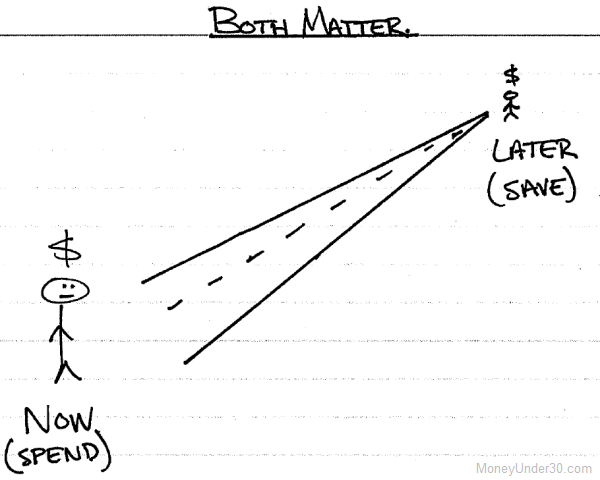
The Physics of Enough: Using Security Math to Kill Guilt
To break free from the trap, we need more than just mantras; we need the security math. One of the most common reasons high earners struggle with guilt free spending habits is a lack of a defined finish line. They are running a race without a fixed distance.
Consider the "Power of 30" formula. If a 30-year-old has 225,000 dollars invested in a diversified portfolio and never adds another penny to it, that money will grow to approximately 3.2 million dollars by age 65 (assuming an 8% average annual return). For many, this calculation provides the logical permission to shift their focus from aggressive saving to lifestyle design.
Reframing how we view money is essential here. Money is essentially a neutral tool, much like a hammer. A hammer has no value if it simply sits in a locked box; its value is realized only when it is used to build something. When you spend money on a gym membership, a therapist, or a course that improves your career trajectory, you aren't just "spending." You are converting liquid cash into self-capital. This logic helps transition toward value-based spending by proving that once the foundation of security is built, the excess should be spent to generate a high happiness ROI today.
The Security Audit Formula: Current Savings × (1 + Interest Rate)^Years to Retirement = Future Outcome. If your Future Outcome exceeds your expected needs, every dollar over your current savings goal is effectively "play money."
Ultimately, we must navigate the paradox of thrift on a personal level. While saving is vital for individual security, failing to circulate your own capital back into your life leads to a stagnation of experiences. We call this the theft of the current self by the future self. To optimize for memory dividends, you must be willing to invest in the tools and experiences that improve your daily life now, rather than just inflating a number on a screen.

Building Your Personal Intentional Spending Plan
Transitioning from defensive to offensive money management requires a structured approach. You cannot simply decide to "spend more" if you have spent years training your brain to feel pain at the point of purchase. You need a system that gives you psychological permission to use your resources.
Start with a "3-Month Biography" audit. Look back at your bank statements from the last ninety days. Instead of categorizing items by "Food" or "Rent," categorize them by "Values." Did this purchase help my health? Did it foster a relationship? Did it save me time? You will often find that a significant portion of your money goes toward invisible costs—things you don't even enjoy—while your true wealth triggers are underfunded.
To implement effective financial balance strategies, use the following comparison to audit your current habits:
| Wealth Triggers (Invest Deeply) | Invisible Costs (Eliminate Aggressively) |
|---|---|
| High-quality sleep tools (mattress, blackout curtains) | Recurring subscriptions for apps you never open |
| Experiences that create lifelong memories with family | Low-quality fast food that leaves you feeling sluggish |
| Services that buy back your time (cleaning, prep) | Interest on consumer debt from mid-tier status symbols |
| Education and skills that increase earning power | Impulse buys driven by social media envy |
| Tools that improve your daily workspace ergonomics | "Sale" items you bought only because they were cheap |
Once you have identified your wealth triggers, the next step is to create sinking funds. These are dedicated buckets of money set aside for specific goals, like a "New Guitar Fund" or a "Japan Travel Fund." By automating the transfer of money into these funds after your retirement goals are hit, you shift the narrative. Spending from a sinking fund isn't a loss; it is the successful completion of a plan. This is the cornerstone of intentional spending for over-savers.
Establishing the 'Money Date' Ritual
Long-term financial health is not about a one-time change in mindset; it is about consistent maintenance. The goal is to move from a state of intensity (aggressive, painful saving) to a state of consistency (balanced, value-based living). One of the most effective ways to do this is by establishing a monthly "Money Date."
Rather than a somber review of expenses, the Money Date should be a celebratory check-in. Instead of focus exclusively on how much you saved, focus on metrics like memory dividends earned. Did you use your travel fund? Did you invest in that new hobby? If you are in a partnership, this ritual is crucial for moving from individual restriction to cooperative financial communication. It allows both parties to agree on what constitutes a high happiness ROI for the household.
During these dates, look at your interest saved on debts or the growth of your investments, but balance that by discussing what is missing from your current lifestyle. Asset distribution should include a plan for enjoyment. This creates a sense of financial contentment because you are no longer viewing your bank account as a fortress to be guarded, but as a fuel tank for the life you actually want to live.
FAQ
What is the definition of intentional spending?
Intentional spending is the practice of aligning your financial outflows with your personal values and long-term goals. It is a proactive approach where you choose to spend money on things that provide genuine utility or happiness, while simultaneously cutting back on mindless or reactive purchases that do not contribute to your well-being.
How do I start practicing intentional spending?
Begin by tracking your expenses for a few months and identifying your wealth triggers—the specific categories of spending that bring you the most joy. Once identified, create a budget that prioritizes these categories after your essential bills and savings goals are met. Automating your savings first gives you the psychological freedom to spend the remainder without guilt.
What is the difference between intentional spending and being frugal?
Frugality often focuses on the "price" of goods and aims to spend as little as possible across all categories. Intentional spending focuses on "value." An intentional spender might be extremely frugal in areas they don't care about, such as generic groceries or an older car, specifically so they can spend extravagantly on areas they value, such as high-end hobbies or meaningful travel.
How can I stop impulse buying and spend more intentionally?
Implementing a "cooling-off period" is often the most effective way to stop impulse buying. When you feel the urge to buy something non-essential, wait 48 to 72 hours before completing the purchase. During this time, ask yourself if the item serves a specific value or solve a recurring problem. Most impulse urges fade when the immediate hit of dopamine subsides.
Why is intentional spending important for financial freedom?
Financial freedom isn't just about having a certain amount of money; it's about having the agency to live the life you want. If you have millions but are too afraid to spend a dollar on a better mattress, you aren't truly free. Intentional spending ensures that you are building the skills to enjoy your wealth as you accumulate it, preventing a mid-life or late-life crisis where you have wealth but no idea how to use it for happiness.